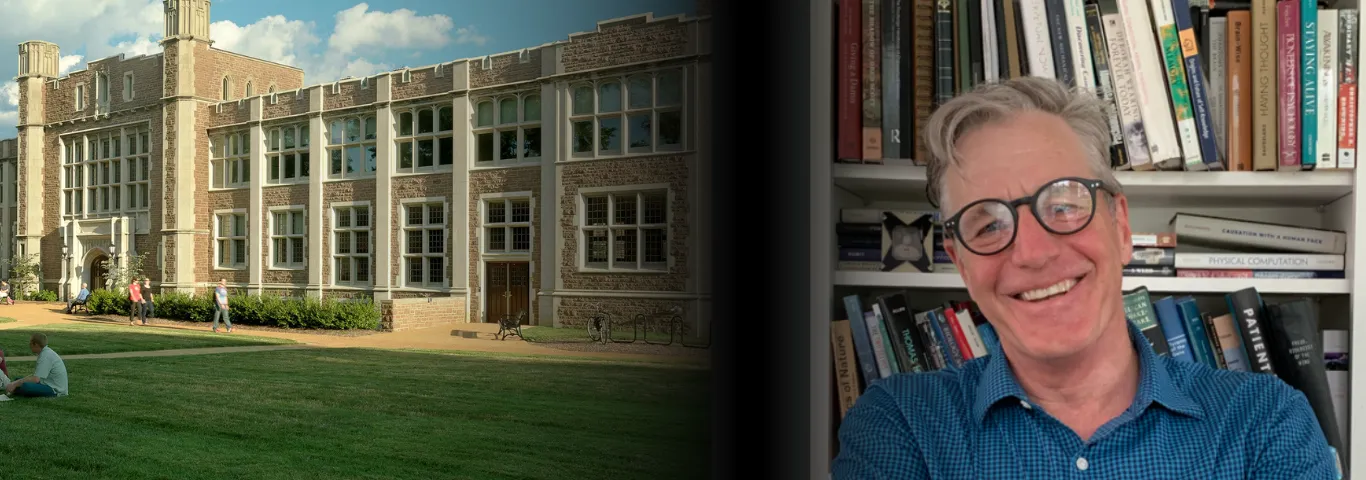
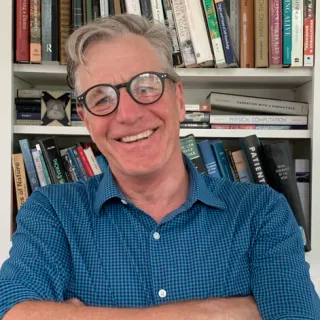
Professor Carl Craver was named Clark Way Harrison Distinguished Professor in Arts & Science in 2026. He is among the most distinguished philosophers in the world and at WashU, so he is a natural choice for the spotlight in this our inaugural departmental newsletter. Dr. Craver joined Wash U as an Assistant Professor in 2001 and is now a Professor of Philosophy and Philosophy, Neuroscience, and Psychology (PNP)
Dr. Craver’s work in the philosophy of science and neuroscience and the philosophy of mind has revolutionized how we understand scientific explanation. As a member of a first generation of philosophers who began to take neuroscience (rather than physics or chemistry) as their focus, Craver emphasized the importance of searching for and explaining phenomena in terms of mechanisms. By exploring what mechanisms are, how they are discovered, and how they are interconnected, gave philosophers of science a fresh perspective on the implicit norms that govern how neuroscience changes over time and by which trends in neuroscience might be evaluated.
In Explaining the Brain: Mechanisms and the Mosaic Unity of Neuroscience (2007), Dr. Craver examined research programs in neuroscience, such as work on action potentials and memory, to reveal that explanations in neuroscience appeal to multiple interconnected mechanisms at different levels (e.g., molecular, neural, behavioral). To explain something like memory, one must appeal to the states and processes that are causally relevant (and manipulable) in producing that phenomenon, including mechanisms that are nested within other mechanisms, and the dynamic interactions among them. Explanation is not about reducing the brain to laws about molecules and cells, but about understanding how things work at many different spatial and temporal scales. The book served as a launching point for several research programs in the philosophy of science generally, as people explored the possibilities and limits of mechanistic explanatory strategies.
In Search of Mechanisms: Discoveries Across the Life Sciences (2013) Dr. Craver and his co-author Lindley Darden (University of Maryland) use the framework developed in Explaining the Brain to examine the discovery of mechanistic explanations in the life sciences more broadly. They used current and historical examples of experiments, observations, and methods across the life sciences to present a powerful account of progress and inquiry in biology. It is a reason-driven search for the multiple dynamic mechanisms that produce and maintain life. As with Explaining the Brain, In Search of Mechanisms has become an essential tool for understanding science that is used not just by philosophers and historians but by scientists themselves.
Dr. Craver and his co-author Shayna Rosenbaum (York University) are about to release a pathbreaking work: Living Without Memory. Most of us have or will experience memory loss personally or within our families. In both philosophy and popular culture, we hear many truisms about what it is to be deprived of memory: it is to be stuck in time, to lose who you are, to have no sense of person or place, to be a moral patient rather than agent—someone to whom things are owed but who is no longer themselves responsible for what they do.

Drs. Craver and Rosenbaum looked at these truisms and noticed something others had not: these are empirical, testable claims, and they might not be true. In a series of experiments, they undermine these truisms and, in doing so, change profoundly our understanding of the role of memory and remembering in human life, in families, and in community. Those who live with profound memory loss are persons, they are not stuck in time, and they have agency and interests. As with his previous works, Living without Memory will be used by scientists as well as philosophers, but it promises to be revolutionary in medical humanities, public health, public policy, and disability studies. It is a deeply human and humane study that demands we recognize those with profound memory loss as people, with lives, who have not only a past and a present but a future.
Dr. Craver’s work embodies what is unique about the PNP Program at WashU: that some questions, like the role of memory in a human life, or the value of explanatory knowledge, can’t be examined adequately absent a philosophical perspective combined with knowledge of the methods and goals of neuroscience and psychology. His scholarly work is cited over 17,000 (!) times, making him among the most cited philosophers of science. To describe him as a giant in philosophy states an undeniable fact, one that acknowledges his sustained influence on scholarly work in philosophy and the sciences over the past quarter century.
Dr. Craver is an innovative and effective educator and mentor to undergraduate and graduate students in Philosophy and PNP. Dr. Craver recently mentored graduate student Judith Carlisle, whose research began with curiosity about post-traumatic stress disorder. She was puzzled by the range of uses of the concept of PTSD and wondered whether all those uses, across so many contexts, were talking about the same thing. The simple question: “Just what is PTSD?” led to an innovative theory of trauma and a Dean’s award honoring excellence in dissertation projects. Judith Carlisle is now an assistant professor at the University of Tennessee. She is just one example of the many, many students Craver has mentored into successful careers.
His work with undergraduates on the racial past of St. Louis is one of Craver’s many passions. He developed a course to enlist and engage students in the effort to learn more about this history and, in particular, Washington University’s place in it. This course led to the development of the St. Louis Integrated Database of Enslavement (SLIDE), an online resource (still in development) that combines different official records (Census, Tax, Baptismal) from which individual stories of enslavement might be constructed.
Many of his students have written prize-winning essays as they combed archives and other resources to tell the stories of individual enslaved people and their contributions to our city’s history. This fall, he’s co-teaching a course on the racial history of WashU’s medical school with Yolanda Wilson, a bioethicist at St. Louis University.

The success of the Philosophy Department and the PNP Program makes WashU a leading institution for educating undergraduates and graduates in the philosophy of mind, the philosophy of science, and the philosophical questions raised by and in scientific work on the mind. The international and national reputation of PNP arises directly from the quality of the faculty. Dr. Craver is at the center of that reputation and leads our mission of providing students with the most advanced, current, and rigorous education possible.