Dr. Daniel Layman writes and teaches about political philosophy and its history. Layman is especially interested in liberty, rights, and the conceptual and historical relationships between them. His current research focuses on the concept of political liberty, both as it figures into early modern political theory and as we ought to understand it today. He is trying to figure out what political liberty is, why it is valuable, and how contemporary puzzles about liberty and its limits developed in the works of modern thinkers like John Locke in the seventeenth century and Henry George in the nineteenth century.
Dan is the author of two books: Locke Among the Radicals: Liberty and Property in the Nineteenth Century (Oxford University Press, 2020) and (with Michael Huemer) Is Political Authority an Illusion? A Debate (Routledge, 2022).
He recently published “Nozick, Self-Ownership, and the Problem of Self-Enslavement” in Critical Review of International Social and Political Philosophy. He also has several pieces forthcoming, including “Nozick beyond Locke: The Nineteenth-Century Foundations of Anarchy, State, and Utopia,” in Cosmos+Taxis, “Locke on Property,” in The Oxford Handbook of Locke, and “Land, Labor, and Freedom: Nineteenth-Century Afterlives of Locke’s Theory of Property” in Locke’s Two Treatises: A Critical Guide.
Before joining WashU, he was Associate Professor of Philosophy at Davidson College. Before that, he held a post-doctoral fellowship in the Political Theory Project at Brown University.
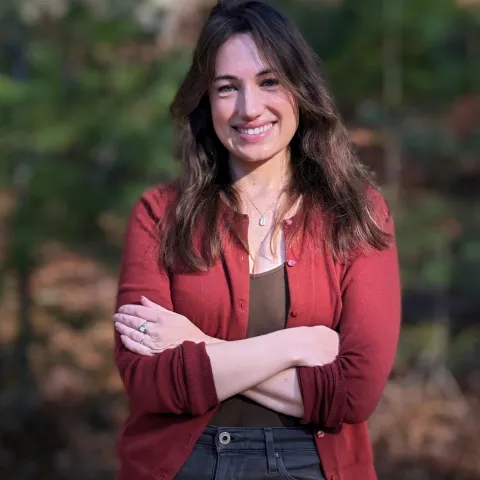
Dr. Alisabeth Ayars’ research interests lie in the mental states most closely tied to evaluation and moral motivation, and their normative significance. Her early work focused on moral psychology. Since then, she has worked on topics including non-cognitivism, the rationality of moral motivation, the role of desire in the good life, responsibility for desire, and moral worth. She is currently completing a series of papers on the nature of emotion, arguing that emotions differ from sensory perceptions in a fundamental way: we cannot “step back” from our emotions as we can from perceptual experiences (such as a visual illusion) because experiencing an emotion already involves taking its object to provide us with reasons to endorse an evaluative construal. Her work has appeared in venues such as Philosophy and Phenomenological Research, Oxford Studies in Metaethics, and Philosophical Studies. She has recently given talks at Purdue University and at the Chapel Hill Normativity Workshop.
This last year she published a paper called, “Moral Worth Beyond Right Reasons,” in Oxford Studies in Metaethics (vol. 21). Another paper, called, “Responsibility for Desire,” is forthcoming in the Oxford Handbook of Philosophy of Desire. A paper she presented at the Chapel Hill Normativity Workshop, called, “Why Illusions are Bracketable, but Emotions Aren’t: Emotions as Pre-Judgmental Takings-as Reasons,” is provisionally forthcoming in Philosophical Studies. She is also currently working on a piece commissioned for the Proceedings of the Aristotelian Society entitled, “The Worth of Moral Worth.”
Alisabeth joined the department after completing a year-long fellowship at the Centre for Ethics at the University of Toronto. Before that, she was an assistant professor at the University of British Columbia. She received her PhD from Princeton University in 2021.

Dr. Jonathan Paramore’s research concerns foundational questions about the nature of linguistic representation. He has focused empirically on understudied languages in Pakistan. He has a number of forthcoming publications, including, “Covert URs: evidence from nasalization in Pakistani Punjabi,” in Natural Language and Linguistic Theory, a book chapter entitled, “Phonetically complete neutralization of vowel nasality in Mankiyali,” in Nasals and Nasalized Sounds, and a book chapter entitled, “South Asia,” in Routledge Handbook of Language Documentation.
He received his Ph.D. in Linguistics with a specialization in Data Science at UC Santa Cruz in 2026.